Village Information
History of Caister-On-Sea
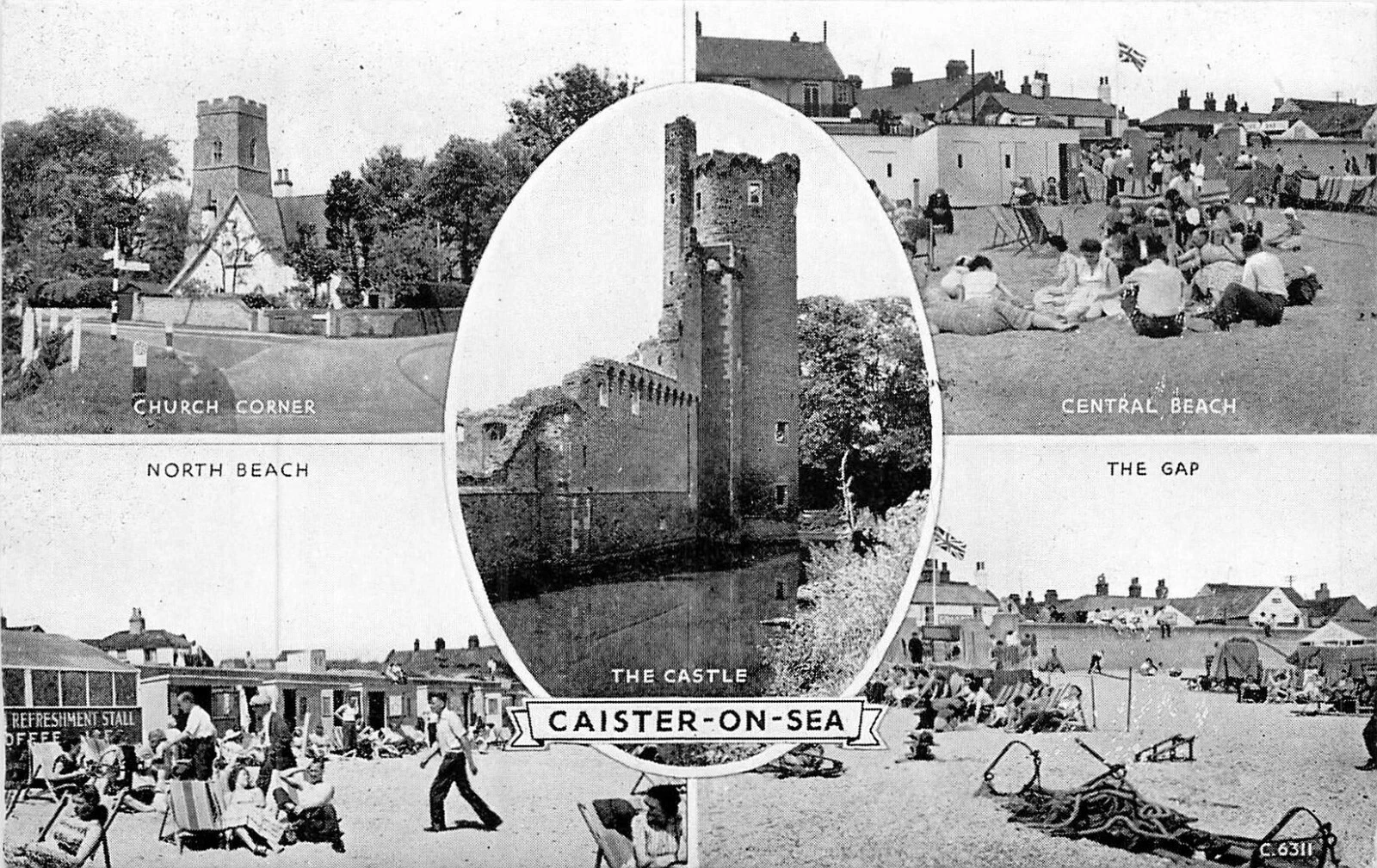
The Beach Village
The first half of the nineteenth century saw the population of Caister more than double. In 1801 it was 498, a figure that had increased to 1,044 by 1851. This rise was mainly due to the development of waste land on the eastern side of the village
that become known as the Beach Village.
In 1800 only a few Caister men made a living from fishing or salvage at sea, the main occupation for most was in agriculture. The coastline was a deserted strip of low sand hills, often frequented by smugglers, the only buildings being a few sheds belonging to the beachmen. The Napoleonic Wars began in 1803 and early the following year a signal station and house were built on the high ground to the north of the village, known as Caister Heights, as part of the coastal defences prepared for a French invasion. The nearest the village came to the sea were a few cottages on the west side of what is now Victoria Street, where some properties today have deeds dating back to at least the 1720s. The 1812 Enclosure map shows there were only six properties along the west side of this street, all having an uninterrupted view across the common and waste land to the sand hills and the sea. The main road to the beach, later named Beach Road, stopped at this point, four tracks then leading through the sand hill to the sea shore. Three of these tracks were closed in 1813 leaving the most southerly to become an extension of Beach Road. The only large building close to the beach, to the north of the village and on the top of the cliff, was the large Manor House, rebuilt in 1794 and by now the home of the Lord of the Manor, Thomas Clowes. The sand hills to the south were his domain, his title also giving him ‘right of wreck’, the ownership of anything washed ashore. Thomas Clowes had a good relationship with the villagers and was a great benefactor and respected member of the community.
By 1815 Robert George had moved to the village from Winterton and built a cottage on waste land at the end of Tan Lane, one room used as a beerhouse. This was later to become the Ship Inn. The Battle of Waterloo, in 1815, brought to an end the Napoleonic Wars and allowed the Yarmouth fishing industry to expand and flourish. One problem was a shortage of manpower and this brought men from the villages to the North of the town to work in the industry. Families from Winterton, California and other small communities to the north migrated the short distance to Caister to be nearer the port, this increasing the requirement for additional housing in the village. This workforce of fishermen worked in both the spring mackerel fishery and the autumn herring fishery, many of them as skippers. The Winterton men, with their superior seafaring skills, began to dominate the Caister beach company which grew during this period to a maximum of 40 members.
Coastguards were first stationed at Caister in 1823 and they had a watch-house and boathouse on the sand hills. The first lifeboat was stationed at Caister in 1845, crewed by the beach company men, and a new look-out was built on the beach in 1846 and a new lifeboat store shed three years later. The main occupation was now moving from agriculture to fishing.
By 1840 the east side of what is now Victoria Street had been developed and the new road became known as East Street and by the time of the 1851 census there were 33 families living in East Street. Later the name was changed, for reasons unknown, to
Horn Street. In the 1840s a new road, later named Clay Road, was built parallel to East Street. The cottages on the east side of this road were built with their backs to the road, facing east onto the Common. The last extension of the beach village came in the late 1860s when a row of houses was built on the south side of Beach Road; also facing the Common (a large part of what was the Common is now a car park). By now there were several structures on the beach belonging to the beachmen and the coastguards, lookouts, watch houses, store sheds and boat houses. By 1900 the name Horn Street had changed to Victoria Street, changed to mark either Queen Victoria’s golden jubilee in 1887 or the diamond jubilee in 1896.
The migration of families from Winterton and other villages had continued into the second half of the century and in the short space of twenty years the population rose by another 400 people, to 1,433 by 1871 and the Beach Village was now firmly established. By the end of this decade there were 18 Caister boat owners, owning between them 14 fishing smacks. Several poor seasons now saw the Yarmouth fishing industry go into decline and many Caister owners had to sell their boats. Steam started to replace sail in 1895 and the industry again flourished, reaching a peak in 1913. Caister owners slowly changed to steam. Nine net warehouses, specialised buildings where the huge quantity of nets used by the Yarmouth boats could be mended and tanned, were built between 1845 and 1875, most of them in the beach village. Caister boat owners, usually owning one boat apiece, each had their own net chamber in the village Net chambers were brick two-storey buildings with a wooden balcony at first-floor level. The ground floor was used to store heavy and bulky items and at one end was a cart shed, the horse and cart essential to transport the nets to the boats three miles away at the Yarmouth fish wharf. The upper floor of the building, with a fireplace at one end to provide warmth in cold weather, was known as the beating chamber where skilled beatsters repaired the
damaged nets. Many women and girls in the village were employed as ‘beatsters’.
As the Yarmouth herring fishing industry disappeared in the 1960s these unique buildings in the village were re-used for a variety of purposes and eventually most were converted into residential accommodation. The last Caister net chamber to go out of use for its original purpose was one in Beach Road, in 1961.
The Political Years
Not many people realise that the emergence of a new political party and the changing political scene in the country at the end of the nineteenth century was responsible for the foundation of what is today the Caister Holiday Centre.
In 1893 a new political group, the Independent Labour Party, was established under the leadership of Keir Hardy, with other notable figures such as Ramsey Macdonald and George Bernard Shaw joining as founder members. The initial idea was for a party to represent the working class, the idea coming from the editor of a weekly Socialist newspaper called the Clarion. The Clarion had been founded in 1891 and, in 1894, the Clarion Cycle Club was formed to ‘spread the word’ to the working classes around the villages and towns of the country. The Clarion soon became a byword for outdoor activity and comradeship, with holidays becoming an important part of the new ILP ethic. In the 1890s cycling became a popular social activity, an activity that was open to both men and woman and for the first time allowing people from the towns and cities to venture out into the open countryside. Most ILP members were members of one of the many Clarion Cycling Clubs that quickly became established throughout the country.
It was against this new Socialist background that John Fletcher Dodd, passing through Caister on a cycling outing, found what he thought was an ideal spot on the northern edge of the village to establish a site where his fellow members could stay for a short holiday. Born in Southampton, Dodd, aged 44, was a teetotaller, a JP, a political activist and a founder member of both the ILP and the Clarion Cycle Club. The club outings were known as ‘labourers’ arcadias’ or fun days. The site which interested Dodd was on the Ormesby Road, at the top of a slight incline just outside the village and only three miles from Great Yarmouth. John Dodd, who had made his money in the grocery business, bought an acre of land from a local farmer on which he built a house which he named Hill House. Three bell-tents were erected in the garden and Dodd was then in a position to invite fellow
members of the ILP to stay, thus founding what was then known as Dodd’s Socialist Holiday Camp. This was the first holiday camp on mainland Britain.
A red flag was flown from a pole in the garden and working-class men from London’s deprived East End were invited to become the first people to enjoy a summer break at Caister. Holidays were at this time usually the reserve of the middle and upper classes and almost unknown to the ordinary working man. This radical idea was initially for men only and Dodd supplied just the tent accommodation and sparse food, everything else was arranged by the campers themselves on a do-it-yourself basis.
The year the camp opened, 1906, was also the year that the Socialists became an established part of the country’s political scene, the Parliamentary Labour Party being founded on 12th February that year. Enough to be able to cater for 200 holidaymakers. Although families were now encouraged to take holidays at Caister, children under the age of two were not allowed. The popularity of the summer breaks at Caister grew rapidly and, by 1910, women were allowed to accompany their men to Dodd’s Camp.
Leading members of the Socialist Party from many parts of the country also visited Caister, among them Keir Hardy and George Lansbury, and discussion groups and political meetings were an important feature of camp life. Dodd’s Camp continued to grow and, after a dispute with the local branch of the ILP, the word ‘Socialist’ was dropped from the name in 1912. Profits were ploughed back into the business and by 1914 the camp was large enough to be able to cater for 200 holidaymakers. Although families were now encouraged to take holidays at Caister children under the age of two were not allowed.
A brochure for 1914 described the facilities of the camp as including a dining hall, although meals were served outside in fine weather, a darkroom for camera enthusiasts, a cycle-shed, flower gardens and a small shop. A clubroom had been built and this was furnished with a piano and used in the evenings for amateur theatricals, lectures, debates and fancy-dress balls. Outdoor entertainment included lawn tennis, croquet and cricket and there was a bathing beach with changing huts. (Campers had to wear the regulation bathing costume, which they could buy from the camp shop). Picnics, rambles and motor tours could be arranged. Breakfast was at 8am, dinner at 1pm, tea at 5pm and supper at 9pm. A bugle summoned everyone to the dining hall at meal times and punctuality was essential. No alcohol was allowed on the camp, which had its own vegetable gardens where
campers were expected to help with some of the everyday tasks. Anyone found ‘talking loudly’ after 11pm could expect to be sent home. The cost of this holiday at Caister in 1914 was twenty-one shillings per week (£1.05).
In the 1920s, land on the opposite side of Ormesby Road leading down to the beach was purchased and the camp expanded towards the sea, now covering 20 acres. By 1924 the camp could cater for 300 guests and the cost of a week’s holiday had risen to two guineas (£2.10), inclusive of all meals and transport to and from the local railway station. Dodd’s strict rules still applied to campers: no alcohol, no gambling or improper language, and no noise after 11pm. All campers were expected to wear the official camp badge at all times and, although many children now attended the camp, the rules still barred those under the age of two. Bathers still had to wear the regulation costumes.
By the late 1920s, several small wooden huts, each eight feet square and containing two single beds, a cold-water tap and an enamel bucket, had replaced some of the tents. Entertainment was arranged by the campers themselves and consisted mainly of games and races, for which they were divided into two teams, the Lions and the Bears. The highlight of the week was carnival day, when most of the campers would dress in a costume appropriate to the chosen theme.
The camp was now open to anyone, irrespective of their political views but Dodd still retained some of his political ideals. He always wore a red tie and once a week, under the flagpole, he gave a talk about Socialism for those that cared to listen. Every Sunday morning, during breakfast in the marquee, Dodd would welcome the campers and always concluded with the words “The glass is going up”.
The 1930s were to bring big changes to the camp, the end of any political association and competition
from new holiday camps. This was also to be the beginnings of the Hi-De-Hi holiday…
The Hi-De-Hi Years
Throughout the 1920s and 1930s holiday camps grew in popularity and numbers. Working people had more money and more leisure time and a reasonably cheap holiday at the seaside, with all entertainment and food included, appealed to thousands of people. The holiday camps be came an established British institution.
In 1920 Potters first camp opened in Hemsby with Maddiesons later in the decade and Seacroft in 1930. In 1931 Captain Harry Warner opened his first camp on Hayling Island, followed by Billy Butlin at Skegness in 1936. Gorleston Holiday Camp opened in 1937 and there were others along to coast towards Lowestoft. Despite the ever increasing competition Dodd’s original Caister Camp flourished.
The 1930s saw new development and expansion at the camp; a new dance hall was opened in 1932 and the brochure for that year claimed; “Demand for huts being great, campers must book early”. The same brochure advertised that the camp was ‘suitable for family parties and people of all ages’, but despite this statement the original rule barring children under two years of age still applied. There were still thirteen camp rules laid down by Dodd, including rule number 7 which stated: “The Camp closes at 11 p.m. and, for general comfort loud talking must not be indulged in after this hour. All lights to be out by 11.30 p.m.”.
The cost of a week’s holiday remained at the 1920s price of two guineas (£2.10), an extra seven shillings (35p) being added for August Bank Holiday week. The ‘dressing bell’ was rung at 7.30am and campers were requested not to bring ‘large luggage’ and not to forget their own soap, towel and boot brushes. Camp transport was available to meet visitors at Caister or any Great Yarmouth railway station, or from the tram terminus at Caister. In the club room holiday makers could read, or play cards and other games and there was a rest room, complete with fireplace, armchairs and sofas (a home from home). New, larger and more comfortable chalets were built, some with verandas and, in 1929, a new dining hall, capable of holding 500 diners, was built. Breakfast was at 8am, dinner at 1pm, tea at 5pm and supper, a simple buffet meal of patties, pies, biscuits and cheese, at 7.30pm. Early morning tea was provided each day at 7am when an urn was taken round to each tent or chalet, the occupants reaching out a hand, clutching a mug, to receive the brew.
In July 1933, the M&GN railway, whose line ran between the eastern end of the camp grounds and the beach, terminating at Yarmouth Beach station, opened a ‘halt’ at the camp. This allowed through trains from London Liverpool Street, known as the Holiday Camp Expresses to stop there on Summer Saturdays. The camp built a two storey station building, with a flight of steps
leading from the first floor down to the platform. The camp was now the only holiday camp in the country with its own main line station. The railway closed in 1959 and all traces of the line have now disappeared. In 1933, when the Gt. Yarmouth and Gorleston tramway system closed, to be replaced by motor buses, Fletcher Dodd bought twenty-two tram car bodies, had them towed to the camp and converted them for use as chalets to accommodate his campers. Dodd’s Camp must then have been the only holiday camp in the country where campers could sleep in old tramcars, a unique experience. Throughout the 1930s a camper’s re-union was held each February at the Royal Horticultural Hall, London. Tickets for this much sought after event were 2/6d (25p).
By 1938 there had been no price rise for thirteen years and the camp could now accommodate 1,000 guests, had a fully-equipped sports ground, lock-up garages and a resident band in the dance hall. The few remaining bell-tents were fitted with electric light but most campers now preferred the new chalets. The red flag had long since gone and the brochures now made no mention of the lectures and political debates that had stimulated the minds of the previous generation of campers. Late in the 1939 season all holidaymakers were sent home and the camp, like almost all holiday camps in the country, was closed and taken over by the military authorities for the duration of the war. The buildings on the west side of the camp were used to house Italian prisoners of war and men from the 2nd Battalion the Sherwood Foresters were billeted in the chalets on the east side of the camp.
The camp was able to reopen to holidaymakers in June 1946 but the rail connection with London was not resumed until two years later. By now, all the tent and tram accommodation had gone and more new, improved, chalets had been built. John Fletcher Dodd died on 21st November 1952, aged 90 and the camp was from then run by his two sons, Charles and Jack, until 1955 when it was sold to a group of Yarmouth businessmen, known as the Caister Group, and headed by Tom Watson.
In 1953, part of the camp opened on 1st February to receive local victims of the disastrous East Coast Floods. Many people from the flooded areas of Great Yarmouth were given temporary accommodation at the camp, some staying for several weeks while their houses were dried out and repaired.
Throughout the 1950s the camp continued to grow and new facilities were introduced. By 1956, there were 340 chalets accommodating over 1,000 visitors and the camp covered 90 acres. This was a decade of rapid growth in the seaside holiday industry; large caravan sites were opening all along the coastline and, by the early 1960s, there were over 100 registered holiday camps in the U.K. The 1950s and 1960s were the peak years for seaside holidays in this country, before foreign package holidays lured people to sunnier climes. Holiday camps around the country were full of people enjoying the simple ‘hi-de-hi’ seaside holiday, a way of life later immortalised in the television programme of that name.
From 1961, special holiday weeks for older people were arranged at Caister, a feature that lasted for many years. An outdoor heated pool, gift shop, Holiday Inn café and bar, new dining rooms, ballroom and reception area were added. By the end of the 1960s foreign holidays had become popular and holiday camps had to change and modernise to attract their customers. In 1973 the camp was acquired by Ladbroke Holidays and renamed the Caister Holiday Centre. The Hi-De-Hi holiday was finished.
Caister at War
In September 1938 a consignment of 2,500 gas masks arrived in the village. The local paper reported that throughout the day school children marched to and from the Council Hall collecting masks and in the evening parishioners queued to be fitted with a mask. The following year, as preparations for war increased, the Council Hall was converted into a First Aid Post under the supervision of the local doctor, Dr Wright. The Parish Council had to move out and hold their monthly meetings at the
school in Beach Road, (now the Community Centre). The Education Authority refused to provide any blackout in the school rooms so the council had to meet in the lobby. By December an agreement was reached with the Rector to hold council meetings in the Church Hall, free during the summer months but a charge of 2/- (later raised to 2/6) per week during the winter to cover heating and lighting costs. This arrangement lasted until 1943 when meetings were resumed in the school. White lines were painted round the electricity posts and lamp posts and on kerbs along Yarmouth Road. Brick, concrete and sandbag blast walls were erected in front of many buildings including the Council Hall. Surface public air raid shelters were provided in many places including Clay Road, High Street, Ormesby Road, Lacon Road, St Julian Road and Yarmouth Road and the schools were provided with Anderson shelters.
Late in the 1939 season, all holidaymakers had been sent home from the Holiday Camp which was taken over by the military authorities. The buildings on the west side of the camp later housed Italian prisoners of war, many of whom would be seen during the day in the village, in their distinctive green prison uniforms. Men from the 2nd Battalion, the Sherwood Foresters, were billeted in the chalets on the east side of the camp. The Old Hall holiday camp was also taken over to house military personnel for the duration of the war.
In 1940, with the threat of invasion increasing, pill-boxes and road blocks were built at strategic points in the village and concrete tank traps built at vulnerable places on the coast, including between the lifeboat shed and Beach Road. It was proposed to provide an Auxiliary Fire Pump in the village, manned by volunteers and for more general use 20 stirrup pumps. Two parishioners volunteered to provide cars to pull the fire pump which was kept in a garage erected on the Kings Arms
car park. A total of 126 fire watchers were required in the village but despite advertisements in the Mercury only 61 people volunteered. The beach was put out of bounds and mines laid. On 24 September 1940 a lone bomb dropped early one morning near the lifeboat shed and detonated a large number of land mines, causing structural damage to houses in Beach Road and Clay Road.
In 1941 the county ARP controller requested the Parish Council to check local defence arrangements and produce a plan of action in case of invasion. A list of pumps and wells in the village was drawn up in case the water mains were disrupted by enemy action. The Parish Council asked for more substantial shelters to protect from increased attention by enemy planes, a request which was not granted. In August 1941 a bomb destroyed two council houses on the corner of Ormesby Road
and Braddock Road with no casualties. The Manor House Hotel had been requisitioned by the military but later had to be abandoned when it began to fall onto the beach due to coastal erosion.
During the summer holidays of 1942 a small section of the beach was fenced off and declared a safe area for the children to play on. A supply of Morrison shelters was received and distributed while the public shelters were reconditioned and some fitted with bunk beds. The Head Warden for the village was Mr C Page, the headmaster of the school and the Civil Defence headquarters were located in a room at the Police Station in the High Street (now a private house). A Home Guard unit
was initially based in a house on Yarmouth Road, later moving to the Old Rectory in Norwich Road (now the Castle Hotel).
In 1942 the Home Guard erected a Spigot Mortar base on one of the allotments, causing damage to crops amounting to 15/-. The Parish Council requested a payment of 2/6 for the loss of a year’s rent. The Golf House at the eastern end of Tan Lane, a converted net chamber, was occupied by the military and was destroyed in 1942 when soldiers inadvertently set off a large amount of explosives. On the high ground at West Caister an anti-aircraft battery, complete with searchlights, was established
(the site now Oak Farm). Two 6 inch ex-naval guns were installed at Nova Scotia farm.
The 1943 Wings for Victory Week raised £70,enough to buy a parachute and camera for a four engine bomber. The allotment holders formed a Garden Produce Association and spare land in the village was cultivated to grow potatoes. A children’s tea was given by the Army to celebrate VE day on 8 May and the village was decorated with flags and bunting. A church parade was held on Victory Sunday, 13 May. In 1945 the authorities were requested to clear the mines from the beach and remove the road block at the end of Beach Road before the summer season. In April that year two children were killed by a mine in the sand hills
and in September two soldiers involved in mine clearance were killed. German prisoners of war were employed in mine clearance between Caister and Yarmouth on the land to the east of the railway but for several years mines appeared both on the beach and in the sand hills.